School Management Software in Cameroon: A Complete Guide
Running a school requires more than delivering lessons. School administrators must manage student admissions, school fees, attendance, academic records, teachers, parents, and countless daily administrative tasks.
For many schools in Cameroon, these responsibilities are still handled through paper registers, physical files, spreadsheets, and separate communication channels. Although these methods may work initially, they can become increasingly difficult to manage as a school grows.
This is why school management software is becoming an important consideration for educational institutions looking to improve organization, reduce repetitive administrative work, and manage information more efficiently.
In this guide, we explore what school management software is, why schools in Cameroon may benefit from it, which features matter most, and how digital platforms such as Akademee can support modern school administration.
What Is School Management Software?
School management software is a digital platform that helps educational institutions organize and manage their academic and administrative activities.
Instead of maintaining disconnected records across multiple registers and spreadsheets, schools can use a centralized system to manage information according to the responsibilities of different users.
Depending on the platform, these systems can include:
Student registration and profile management.
Class, subject, and academic-year organization.
Teacher and staff administration.
Student attendance tracking.
School fee records and payment monitoring.
Academic marks, results, and report cards.
Parent and student portals.
Administrative reports and school records.
The objective is simple: help schools manage their operations in a more organized, accessible, and consistent way.
Why Do Schools in Cameroon Need School Management Software?
Cameroon has a diverse educational landscape, including private and public schools, bilingual institutions, technical colleges, vocational establishments, and higher education institutions.
Despite their differences, many schools face common administrative challenges.
1. Student Records Can Become Difficult to Manage
Student information is essential to school operations. Administrators regularly need to retrieve admission details, contact information, class assignments, academic history, and other records.
When information is scattered across paper files and separate spreadsheets, retrieving it can consume valuable time. Duplicate records and inconsistent data can also create unnecessary complications.
A digital student management system provides a more structured way to maintain student information and retrieve records when needed.
2. School Fee Tracking Requires Careful Organization
Managing school fees is one of the most important administrative responsibilities in many private schools.
Accountants and school administrators may need to record payments, monitor outstanding balances, verify transactions, issue receipts, and prepare financial reports.
A school fee management system can help centralize payment records and make it easier to identify outstanding balances.
Digital records do not eliminate the need for proper accounting procedures, but they can make financial information easier to organize, review, and reconcile.
3. Manual Attendance Tracking Takes Time
Teachers often need to record attendance for multiple students across different classes and sessions. Administrators may then need to consolidate this information to identify absences or review attendance patterns.
A digital attendance management system can simplify the recording and review of attendance information, depending on the features available.
This can help schools maintain more accessible records and identify situations that may require follow-up with students or parents.
4. Academic Reporting Can Be More Efficient
Preparing report cards and consolidating examination results can involve considerable work when marks are recorded separately.
School management software can help organize assessment records and support the preparation of academic reports. Depending on the platform, it may also automate calculations according to configured grading rules.
Schools should ensure that their chosen software supports their academic structure and reporting requirements before adopting it.
5. Communication Between Schools and Parents Matters
Parents need access to relevant information about their children's academic progress and school activities.
A platform that provides appropriate parent and student access can make information easier to retrieve and help schools communicate more systematically.
Features such as report access, announcements, and attendance information can support communication when they are available and properly configured.
Essential Features to Look for in a School Management System
Choosing the right school management software requires more than selecting a platform with an attractive interface. The system should address the school's actual operational needs.
Here are some important features to consider.
Student information management: The ability to maintain student profiles and organize essential school records.
Fee and payment management: Tools for recording payments, monitoring balances, and reviewing financial information.
Attendance management: A structured way for authorized teachers to record attendance and administrators to review it.
Academic management: Support for classes, subjects, assessments, results, and report cards.
Role-based access: Separate permissions and appropriate interfaces for administrators, accountants, teachers, students, and parents.
Reporting: Access to useful summaries that support administrative planning and decision-making.
Accessibility: A responsive interface that works across supported computers, tablets, and smartphones.
Data protection: Appropriate authentication, access controls, secure data handling, and reliable backup procedures.
Scalability: The ability to accommodate the school's future needs as its student population and administrative requirements change.
Before committing to a platform, school leaders should verify which features are currently available, what the system costs, how onboarding works, and what support is provided.
How Akademee Supports Digital School Administration
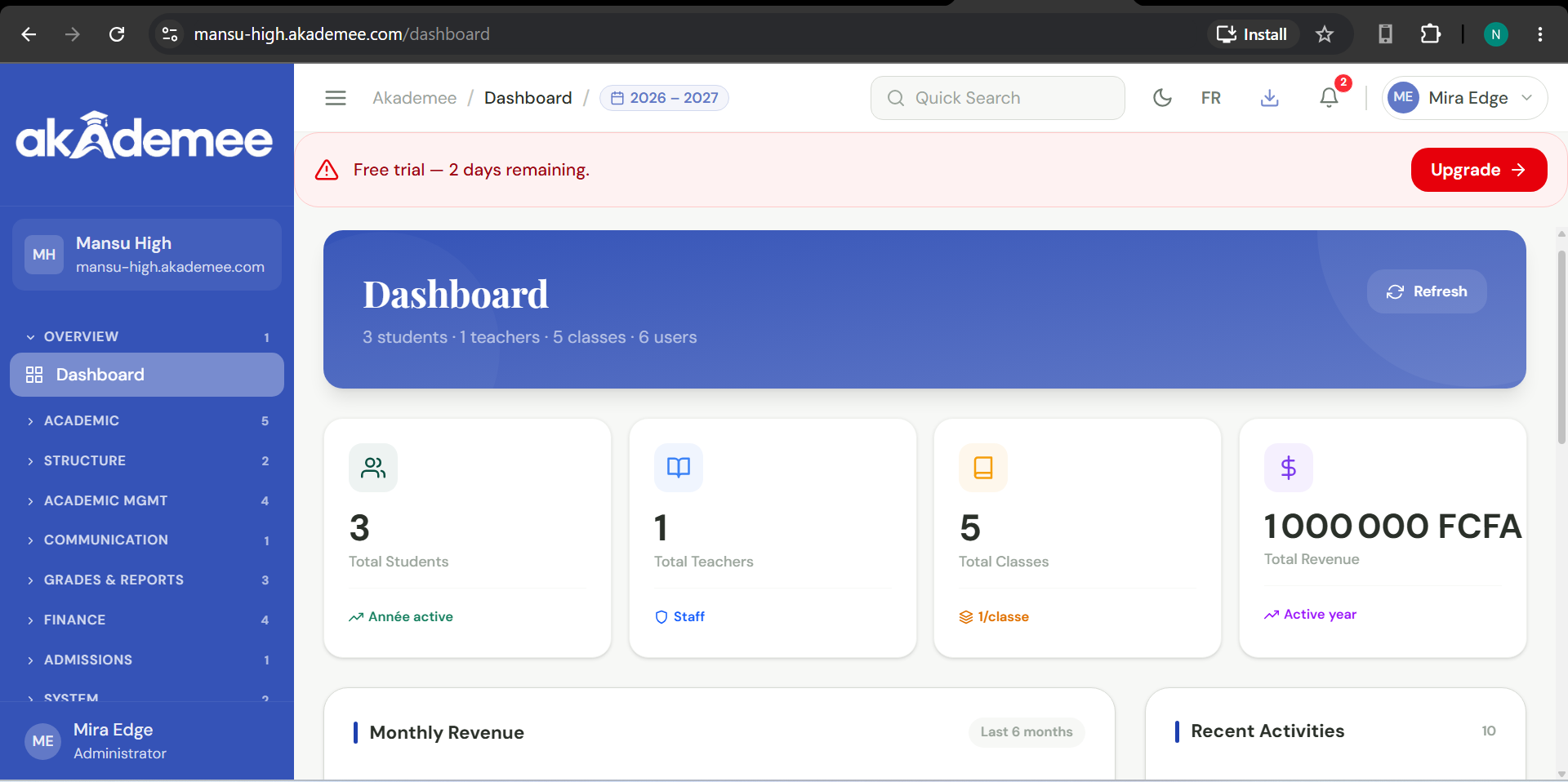
Akademee is a school management platform developed under Mira Edge Technologies to support the digital organization of school operations.
The platform is designed around the different roles involved in running an educational institution, including the Super Admin, School Admin, Accountant, Teacher, Student, and Parent.
This role-based approach provides a foundation for organizing access to the information and functions relevant to each user.
Akademee also follows a multi-school architecture designed to support individual school environments, including school-specific configuration and customization.
For educational institutions exploring digital transformation, the goal is to make school administration more structured by bringing relevant operations into a coordinated platform.
Rather than relying exclusively on disconnected tools and manual records, schools can explore how a dedicated school management system may fit their administrative processes.
As with any software platform, schools should review the current features and confirm that the functions they need are available before making a decision.
To learn more, visit the official Akademee website and explore how the platform may support your institution.
Is School Management Software Suitable for Small Private Schools?
Yes. School management software can be useful for small private schools as well as larger institutions, provided that the platform meets their needs and budget.
A smaller school might initially prioritize student records, fee tracking, and attendance management. As it grows, it may require more advanced reporting, additional user roles, and broader academic administration capabilities.
The important thing is to identify the school's most pressing challenges and select a system that addresses them without introducing unnecessary complexity.
School leaders should also consider staff training, data migration, ease of use, ongoing support, and the security of student information.
How to Introduce School Management Software Into Your School
Transitioning from manual administration to digital management is easier when the process is planned carefully.
Step 1: Identify Your Administrative Challenges
Determine which activities consume the most time or create the most errors. These may include admission records, fee tracking, attendance, or academic reporting.
Step 2: Organize Your Existing Records
Review current records and establish consistent formats for student details, payment information, classes, and other essential data.
Step 3: Evaluate Available Platforms
Compare school management systems based on functionality, usability, security, cost, support, and compatibility with your school's requirements.
Step 4: Prepare Your Data Carefully
Before transferring records, check their accuracy, remove duplicates where appropriate, and ensure that sensitive information is handled responsibly.
Step 5: Train Teachers and Administrative Staff
Give users practical guidance on how to perform their everyday tasks within the new system.
Step 6: Review Your Progress
After implementation, evaluate whether the platform is improving recordkeeping, reducing repetitive work, and making information easier to access.
A gradual and well-organized transition can help staff adapt while minimizing disruption to normal school activities.
The Future of School Administration in Cameroon
Digital transformation in education is not simply about replacing paper with computers. It is about finding better ways to organize information, coordinate responsibilities, and support informed decisions.
School management software cannot replace effective leadership, good teaching, or sound educational policies. However, the right system can provide valuable administrative support and help schools establish more consistent processes.
For schools in Cameroon, evaluating digital management solutions is an opportunity to address existing administrative challenges while preparing for future growth.
Akademee is part of this movement toward more organized school administration through technology.
Are you looking for a more organized way to manage your school? Explore Akademee to learn more about school management technology and discover whether the platform meets your institution's needs.
Akademee is developed under Mira Edge Technologies.

Comments (0)
No comments yet. Be the first to comment!
Leave a Comment